We've profiled coffee, cocoa, rubber, wood, soy and palm oil in this series. Cattle is the last, and structurally the hardest, for a reason none of the other six share: a coffee tree and a cocoa pod stay where they were planted. A cow doesn't.
The largest deforestation driver by a wide margin
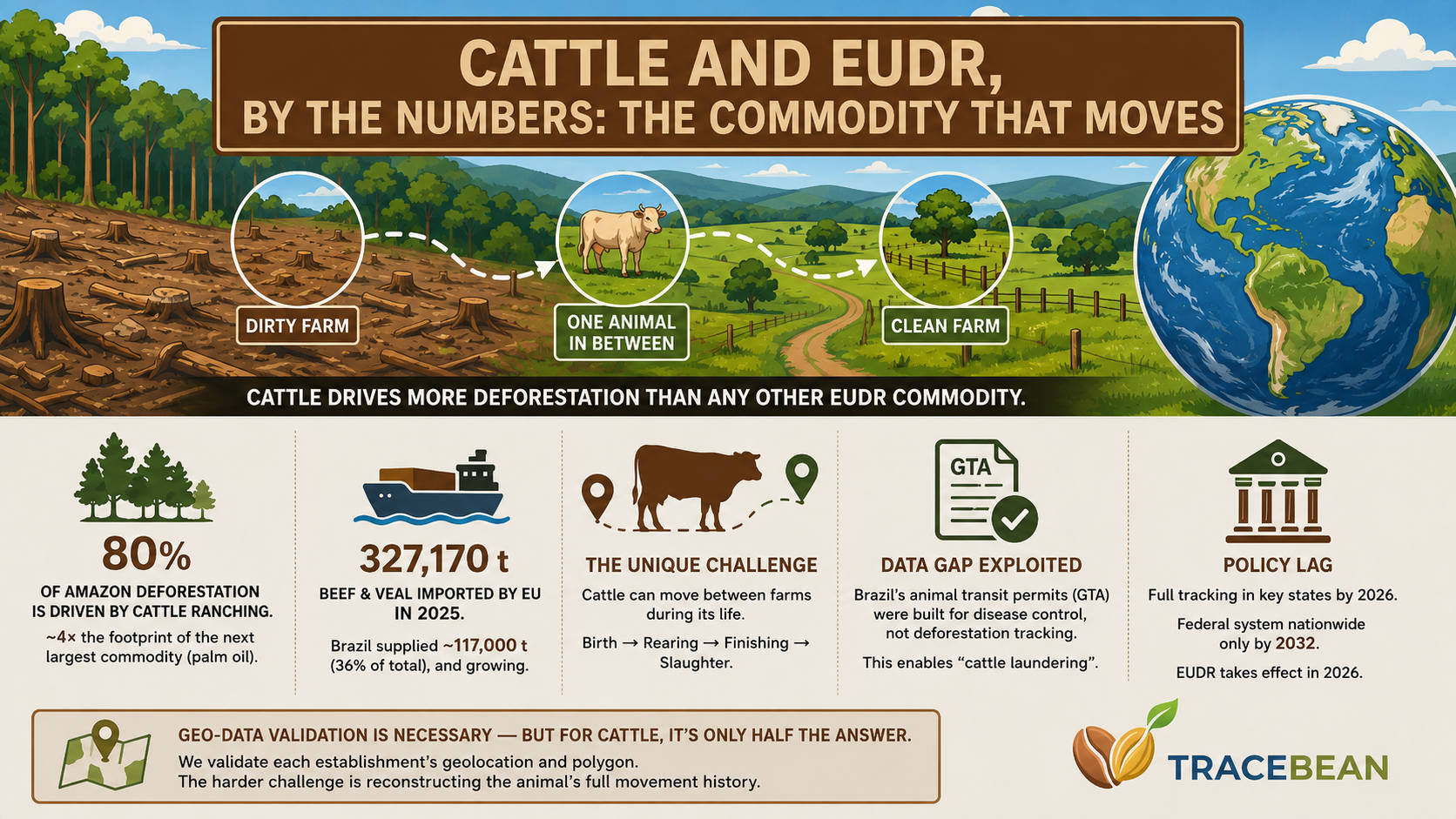
Cattle ranching drives an estimated 80% of Amazon deforestation, and cattle pasture expansion in Brazil has a deforestation footprint roughly four times larger than the next biggest commodity globally — palm oil from Indonesia. The area involved is often described in a single striking comparison: forest loss linked to Brazilian cattle pasture roughly the size of Poland.
Where the EU's beef actually comes from
The EU imported 327,170 tonnes of beef and veal in 2025. Brazil alone supplied about 117,000 tonnes, worth $955 million — roughly 36% of total EU import volume, and growing fast: Brazilian export volumes to the EU rose 26% in the first nine months of 2025, with Argentina up 21% and Uruguay up 32% over the same period. Most of this trade moves through the Hilton Quota, an EU mechanism allowing a limited volume of premium cuts — tenderloin, ribeye, sirloin — at a reduced tariff around 20%, which is part of why Brazil positions its EU-bound beef as a high-value product rather than bulk commodity volume.
The problem no other commodity in this series has
Every other commodity we've covered reduces, eventually, to a question about a plot: is this polygon structurally valid, does it sit inside the country it claims, was it forest on the cutoff date. Cattle adds a dimension none of them have. An animal born on one ranch can be moved to a second for rearing and a third for finishing before reaching a slaughterhouse — and Brazil's own transit permits, the Guia de Trânsito Animal (GTA), were originally designed for disease control, not deforestation tracking. That gap is exactly what "cattle laundering" exploits: moving cattle from a ranch linked to recent deforestation to a "clean" intermediary ranch shortly before sale, so the animal's final, visible origin carries no red flags.
JBS was found buying cattle from two farms in Pará linked to nearly 1,400 hectares of deforestation in 2025, with 89 fire alerts recorded across both locations, supplying JBS slaughterhouses directly between September and December of that year. A broader analysis tracking farms supplying JBS, Marfrig and Minerva Foods found over 109,000 hectares deforested between August 2023 and September 2025 — JBS alone accounting for 62% of that total.
A separate investigation into the Pantanal wetlands used the GTAs themselves, cross-referenced against satellite data, to trace 190 farms responsible for 426 square kilometres of clearing between 2019 and 2023, all supplying the same three meatpackers. The tool built to stop disease from spreading turned out to be exactly the record needed to expose where the animals had actually been.
Why indirect suppliers are the real gap
JBS does not currently track its indirect suppliers — the ranches that sell to intermediary farms rather than directly to a slaughterhouse — and has pledged to require direct suppliers to declare their own indirect suppliers only by January 2026. Regulatory progress is similarly uneven: Pará's state government mandated full animal-movement tracking by the end of 2026, but the federal plan to extend equivalent systems across all of Brazil doesn't have a deadline until 2032 — six years after EUDR itself takes effect. Until then, illegal farms in one state can continue laundering cattle through ranches in another, exactly as Human Rights Watch documented between Pará and Mato Grosso.
A structurally perfect polygon for the "clean" ranch doesn't tell you what happened at the two ranches before it. For cattle, geometry validation answers a real but narrower question than it does for any other commodity in this series.
Where this leaves the fit assessment
Geo-data validation still matters here — every ranch in a chain, "clean" or not, is a geolocated establishment that needs a structurally valid polygon before anyone can reason about what's inside it, and Brazil's scale (the world's largest commercial cattle herd) means there's no shortage of establishments that need exactly that check. But cattle is honestly the one commodity in this series where geometry validation, on its own, addresses the smaller half of the actual problem. The harder question isn't whether any single ranch's polygon is valid. It's whether the animal's full movement history — ranch to ranch to slaughterhouse — has been reconstructed at all, which is a traceability-over-time problem, not a geometry-at-a-point-in-time one.
For cattle, we validate what we're built to validate: that each establishment in a supply chain has a structurally sound, correctly located geolocation record. What we don't solve — and what no geometry tool solves on its own — is whether an animal's recorded movement history reflects where it actually spent its life. That gap is closed by systems like Brazil's own GTA tracking, once it actually covers the whole country, not by better polygons.
Seven commodities in, the pattern holds: geo-data validation is necessary everywhere in this series, and sufficient on its own almost nowhere.
Deforestation and cattle-laundering findings are drawn from Mighty Earth's Rapid Response reporting (April 2026), Human Rights Watch's "Tainted" report on JBS (October 2025), Unearthed/Greenpeace's Pantanal investigation (November 2024), and The Bureau of Investigative Journalism (November 2025). Trade figures are drawn from AHDB's EU beef market analysis (November 2025), Eurostat, and Brazilian trade press (December 2025).
← Back to Blog