We wrote recently about cattle as the largest deforestation driver among EUDR's seven commodities — and about how the animal itself, moving between ranches, creates a traceability problem none of the other commodities share. This piece is about a different kind of gap in the same supply chain: what happens when a regulator's own evidence points one way, and the final decision points another.
What changed, precisely
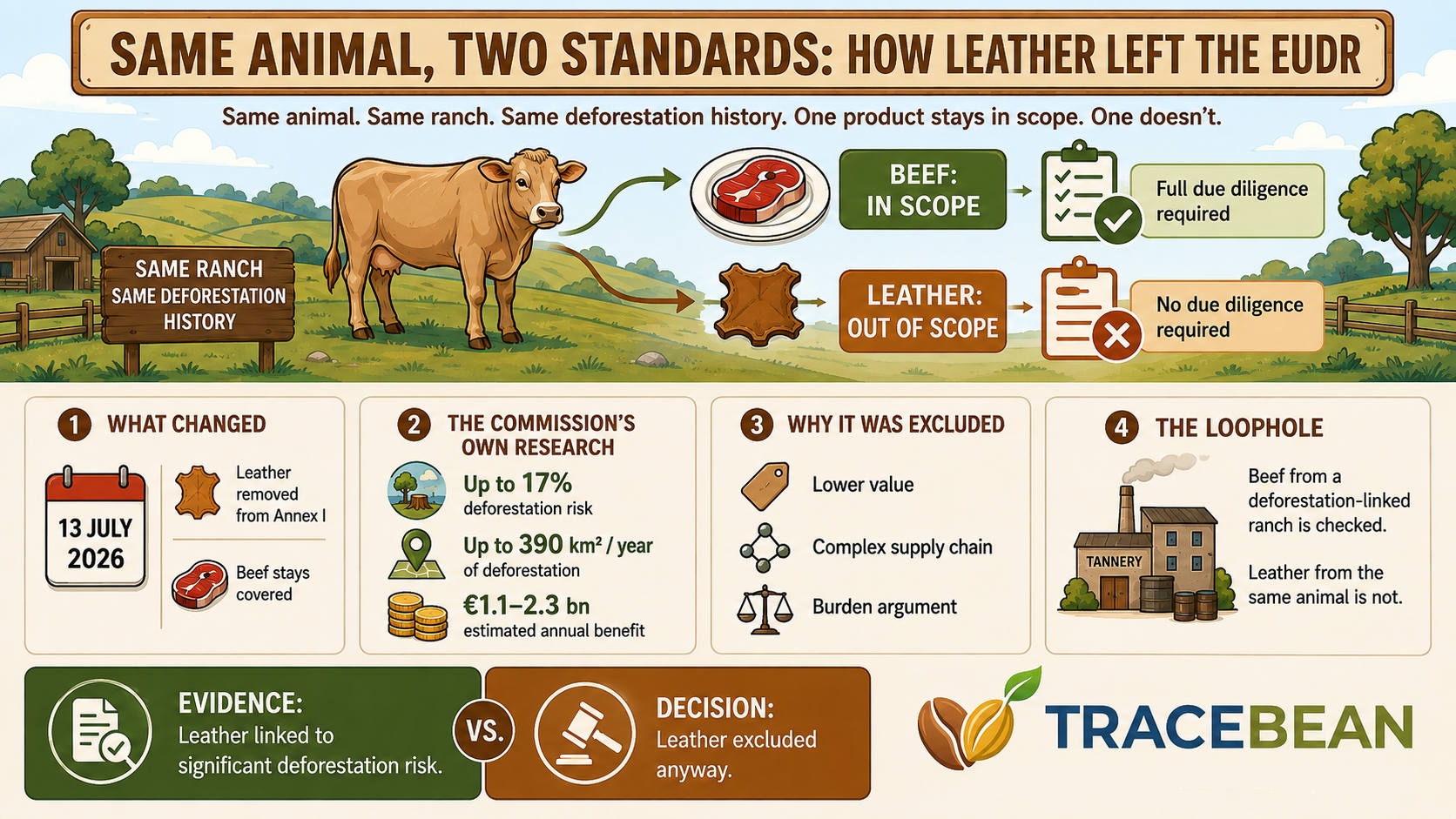
On 13 July 2026, the European Commission adopted a Delegated Act removing three HS codes from Annex I of the EUDR: raw hides and skins of cattle, tanned or crust hides, and finished leather. Cattle itself remains one of the regulation's seven covered commodities — beef, veal and other meat and offal products stay fully in scope. Only the hide, and everything made from it, is now exempt. The act is currently in a two-month scrutiny period before the European Parliament and Council; barring objection, it takes binding effect once published in the Official Journal, expected around mid-September 2026.
What the Commission's own research found
Before proposing the exclusion, the Commission's Staff Working Document — the impact assessment meant to support the decision — modelled leather's deforestation footprint under two scenarios: treating it as a low-value byproduct of beef, or as a genuine co-product of the cattle supply chain. Depending on the approach, the document estimated leather could be associated with up to 390 square kilometres of deforestation a year — roughly twice the size of Pisa — representing as much as 17% of the total deforestation risk linked to every commodity the regulation covers. The same analysis put the environmental benefit of keeping leather in scope at €1.1–2.3 billion a year.
The Commission's stated justification for excluding it anyway centred on three points: leather has lower economic value than the meat from the same animal, its supply chain is complex and fragmented enough that operators have "limited leverage" to obtain upstream data, and including it would create disproportionate burden relative to that value. Each of those points is arguable on its own terms. None of them addresses the 17% figure directly.
The lobbying record is not hidden — it's just rarely read alongside the impact assessment
In June 2025, Italy's Deputy Prime Minister and Foreign Minister, Antonio Tajani, wrote directly to Commission President Ursula von der Leyen and Trade Commissioner Maroš Šefčovič requesting leather's exclusion from EUDR, or failing that, substantial simplification. In parallel, the US leather trade associations LHCA, COTANCE and the International Council of Tanners engaged the US Trade Representative and USDA to press the same case with EU institutions. The Commission published its draft exclusion proposal on 4 May 2026, a public comment period closed a month later, and the act was formally adopted on 13 July — roughly thirteen months after Tajani's letter.
The lobbying trail runs wider than two letters. In April 2026, Italian MEP Dario Nardella convened a Brussels event where the European leather industry made its case directly to Commission cabinet staff and fellow MEPs, backed by diplomatic representatives from Canada, the US, Australia, Sweden, India, Vietnam, Japan and Brazil. Investigative reporting by Earthsight found Italy's tanning association had held recorded meetings with far-right parliamentary groups specifically to discuss the exclusion, alongside meetings across the political spectrum. The industry also brought its own science to the debate — a University of Pisa researcher argued at the same event that leather isn't a meaningful deforestation driver, a claim that sits directly against the Commission's own 17% figure rather than alongside it. By June, Commission officials were reportedly holding their position despite pushback from a number of MEPs inside Parliament itself, not only from outside campaigners.
What the loophole actually allows — a live example
Cattle from Fazenda Asa Branca, a farm linked to deforestation in Pará, were likely slaughtered at a nearby JBS facility, according to cattle transfer records reviewed by investigators. That slaughterhouse sits next to one of JBS's own tanneries. Under the amended Annex I, the beef from that animal remains subject to full EUDR due diligence. The hide — quite possibly processed at the tannery next door — no longer does.
This isn't a hypothetical illustration. It's the same investigation we cited for the cattle-laundering mechanism, describing the same supply chain, the same company, the same animal. The exclusion doesn't need to be exploited deliberately to matter here — it simply removes a check that would otherwise have applied to exactly this kind of case.
The gap is about to get sharper, for an unrelated reason
Days after this exclusion takes its final legal form, a separate EU measure makes the same split even starker. From 3 September 2026, the EU is removing Brazil from its list of countries authorised to export products of animal origin — including beef — over insufficient guarantees on antimicrobial use in livestock, under Commission Delegated Regulation (EU) 2023/905. That measure has nothing to do with EUDR or deforestation; it's a food-safety and antimicrobial-resistance rule. But the products it covers are consistently listed as beef, poultry, horse meat, fish, eggs, honey and casings — with no mention, across the sources we checked, of raw hides, tanned hides or finished leather.
Put the two measures side by side and the timing is almost too neat: as of early September, beef from a Brazilian ranch may be legally barred from the EU altogether, for reasons unrelated to deforestation, while the hide from the same animal remains free to enter, for reasons unrelated to antimicrobials. Neither rule was written with the other in mind. Together, they leave leather as close to the only unencumbered path from a Brazilian cow to the EU market that current regulation allows.
The economic stakes, briefly
Leather is not a marginal side-business. In 2024, it represented roughly a quarter of the value of all cattle products imported into the EU under EUDR's scope — around €240 million from Brazil alone. Brazil exports about 80% of the hides it processes, and the EU is Brazil's second-largest hide export market, and Paraguay's largest. That scale is precisely why the trade-flow-asymmetry argument cuts both ways: an industry large enough to matter economically is, by the same logic, large enough to be asked for better data rather than exempted from providing any.
Leather isn't the only Annex I entry the same delegated act touched — retreaded tyres, soybean seeds for sowing, and several rubber and vehicle-parts categories were also removed. Those changes drew far less controversy, and for a clear reason: they came with coherent, uncontested technical justifications and no equivalent impact-assessment finding contradicting the decision. Leather is the one exclusion where the regulator's own numbers and the regulator's own choice point in opposite directions.
A beef shipment from a deforested ranch will be stopped at the EU border. A leather shipment from the same ranch, the same animal, the same tannery, will not be. That isn't a data gap. It's a scope decision, made with the relevant data already in hand.
What's still open until 13 September
The Parliament and Council can still object during the scrutiny window, though the Commission held its position through the consultation period and observers consider a veto unlikely. Dutch MEP Catarina Vieira, who supports keeping leather in scope, has been publicly encouraging EU citizens to contact the Commission directly before the window closes: "Someone has to lobby to make it come back. NGOs already do it, but citizens can do it too." Worth knowing the mechanics of that veto, though — Parliament and Council can only accept or reject the delegated act as a whole. There's no procedural path to strike just the leather exclusion while keeping the rest, including additions like soluble coffee that nobody has objected to.
Where this fits alongside what we've already found
This is the same shape of problem we described in Legal on Paper, Illegal on the Ground — a gap that isn't a data-quality failure, but a place where the rules themselves stop looking. There, it was a permit that didn't match satellite evidence. Here, it's a scope boundary drawn through the middle of a single supply chain, separating a product the regulation still checks from a product, made from the identical animal, that it no longer will.
This one is outside our lane, and we want to be direct about that: which products a regulation covers is a policy question, not a geo-data one, and we're not positioned to weigh in on where that line should sit. What we can say is narrower and doesn't depend on the outcome: a ranch's geolocation doesn't become less real because a downstream product made from its cattle is no longer in scope. Whatever gets regulated, knowing exactly where it came from stays the same problem.
Impact assessment figures are drawn from the European Commission's Staff Working Document accompanying the EUDR simplification package, as reported by Mongabay (May 2026). Lobbying details are drawn from Earthsight, the EIA, Rainforest Foundation Norway, Mongabay, Eco-Business, and Cotance's own press coverage of the April 2026 Brussels event. Parliamentary pushback and the scrutiny-period mechanics are drawn from Carbon Pulse (June 2026), Linklaters, and EUDR Navigator legal analyses (July 2026). Trade figures are drawn from Mighty Earth and the EIA's briefings on leather's inclusion case. The Fazenda Asa Branca case is drawn from Mighty Earth's Rapid Response reporting (April 2026), as cited in our previous post on cattle. The antimicrobial-ban scope is drawn from the British Agriculture Bureau, Rio Times, Agência Brasil and The Poultry Site (May–July 2026); no source we reviewed lists hides or leather among the affected product categories, though we have not confirmed this against the delegated regulation's full text directly.
← Back to Blog