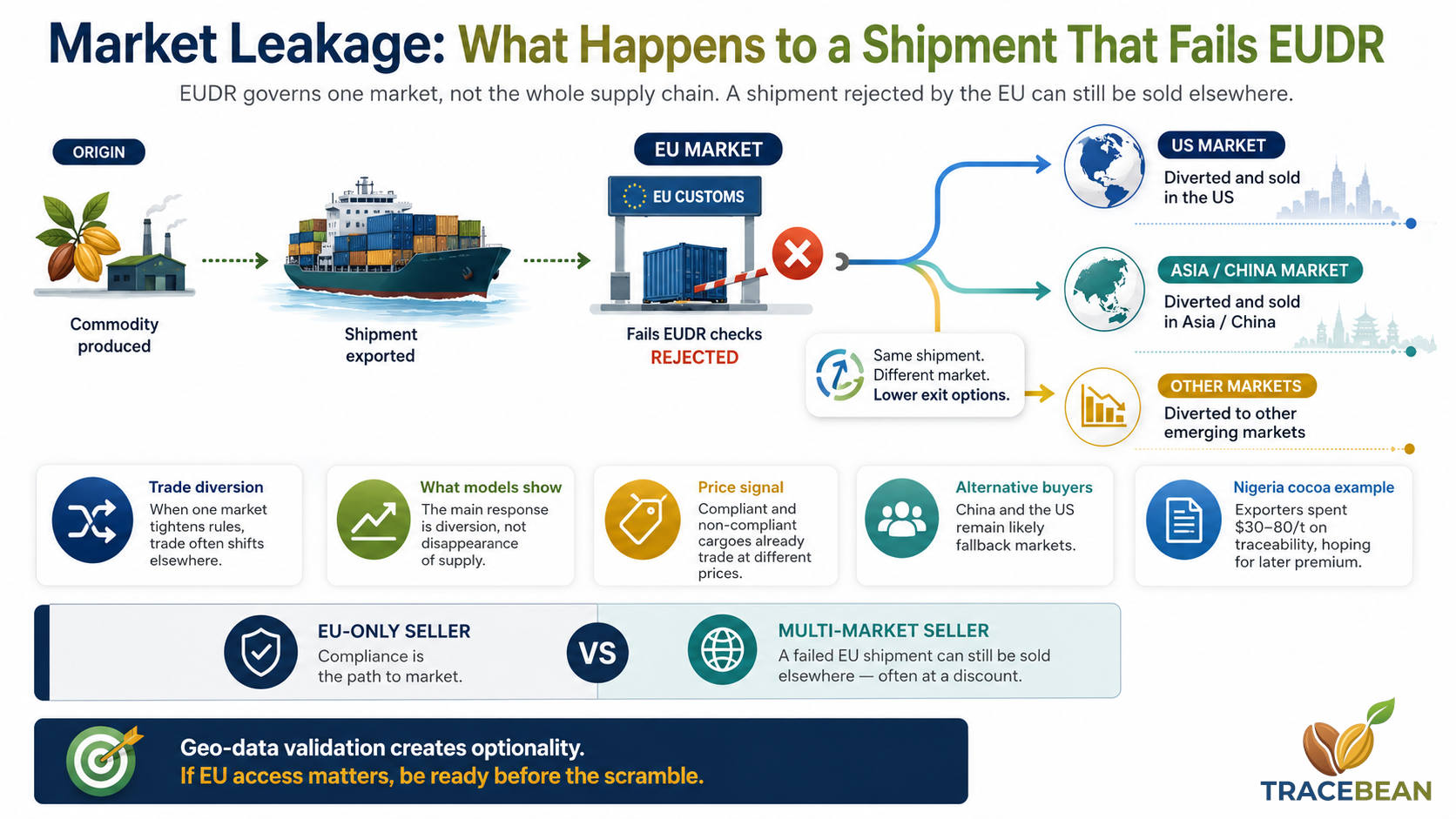
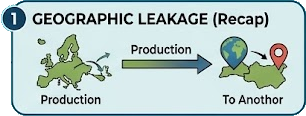
We wrote recently about geographic leakage — how cutting off deforestation-linked production in one region routinely displaces it to the next, less-protected one. There's a second, related mechanism worth its own treatment: what happens to a shipment after it's already been produced, when it fails to meet EUDR's requirements. It doesn't have to disappear. It can be sold somewhere else.
A named, studied phenomenon — and not a new one
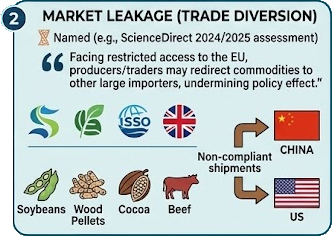
Trade economists call this market leakage or trade diversion, and it predates EUDR by well over a decade. Research on tropical timber found exporters shifting sales toward less-stringent markets whenever a major buyer tightened its rules, well before the EU passed anything resembling its current regulation. A recent academic assessment of EU-China policy alignment states the mechanism plainly: facing restricted access to the EU, producers and traders may simply redirect commodities grown on deforested land toward other large importers — China chief among them — undermining the policy's intended effect elsewhere.
The modelling already shows where this goes
A dynamic spatial equilibrium model published in early 2025, covering fourteen global regions and specifically built around EUDR-driven wood pellet trade, reached a clear conclusion: the dominant market response to the regulation is trade diversion, not reduced demand. Under joint EU-UK implementation, the model projects a 7.2% production decline in the US Southeast — historically a major pellet exporter to Europe — by 2030, while EU and UK domestic producers expand output by 1.6–7.1% through import substitution. The wood doesn't stop being cut. The buyer changes.
It's already priced into the market, before enforcement even starts
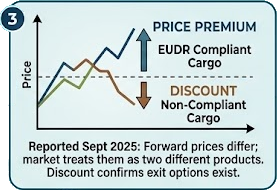
Traders in refined palm kernel oil from Malaysia and Indonesia are already quoting different forward prices for EUDR-compliant and non-compliant cargoes bound for Europe — a risk premium building into offers specifically for shipments arriving close to enforcement deadlines. The market isn't waiting for enforcement to begin treating compliant and non-compliant supply as two different products with two different prices.
A price gap like this is itself evidence of an exit option. If non-compliant supply had nowhere else to go, its price would simply collapse rather than trade at a discount to compliant supply.
Who's on the other side of that discount
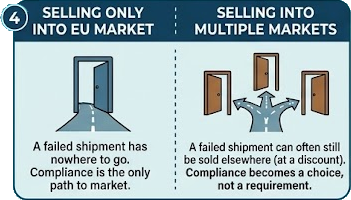
The destinations aren't hypothetical. China is repeatedly named in the trade-diversion literature as the most likely alternative buyer for commodities that can't clear EU requirements — already the world's largest importer of soybeans, with no deforestation-linked import restriction of its own. The US currently has no equivalent regulation either; in fact, the USDA has actively lobbied Brussels to have the US reclassified as "no risk" under EUDR's own country system, even as UN data attributes roughly 120,000 hectares of annual forest loss to the US itself. The UK has had a narrower framework — covering illegal deforestation only — on the books since 2021, without the secondary legislation needed to actually enforce it.
A live example: when the investment hasn't paid off yet
Two of Nigeria's largest cocoa exporters illustrate the calculation directly. Sunbeth Global spent three years mapping 124,000 hectares of farmland, covering roughly 60,000 tonnes of cocoa, at $30–70 per tonne. Starlink Global and Ideal, Nigeria's biggest cocoa exporter, spent $40–80 per tonne tracing a similar volume since 2023. Neither company has recovered those costs from European buyers — by the low end of each range, that's over $2 million spent per company with no reimbursement so far. Industry estimates suggest more than half of Nigeria's cocoa, grown by roughly 300,000 mostly small-scale farmers, still won't meet the requirement when it takes effect.
One nuance worth holding alongside the market-leakage argument: a former global cocoa trader quoted in the same report expects a roughly two-year supply squeeze once enforcement starts, during which exporters who invested early would command a premium from chocolate makers rather than a direct reimbursement. If that holds, the return on Sunbeth and Starlink's spending may come from scarcity pricing later, not from the EU buyers who pushed back on the cost now.
Cocoa also has less of an exit option than soy. West Africa supplies about 70% of the world's cocoa, and roughly two-thirds of that goes to the EU specifically — a narrower alternative-market cushion than soy's ready buyer in China. That should, in principle, make the compliance investment easier to justify. Whether it actually will depends on whether the promised premium shows up before the cash flow pressure does.
Why this changes who actually needs geo-data validation
This is where market leakage becomes a practical question rather than an academic one. The EU is a large market but rarely an exclusive one — for US agricultural exporters alone, it's the second-largest destination for soybeans, the fourth for forest products, the eighth for beef. A company selling primarily into China or the US, with the EU as a secondary or occasional market, faces a genuinely different calculation than one for whom the EU is the primary or only outlet. The first can treat non-compliance as a cost of doing business elsewhere. The second cannot.
Market leakage doesn't make geo-data validation unnecessary. It makes it conditional — valuable in direct proportion to how much a company's revenue actually depends on EU market access, rather than something every producer in a covered commodity needs equally.
Where this leaves the honest answer
We'd rather say this plainly than let it go unsaid: for an operator who sells the large majority of their volume outside the EU, EUDR compliance may genuinely be a smaller priority than for one whose business depends on the EU market specifically. That's not a reason to abandon due diligence — reputational and downstream-buyer pressure exist independent of EUDR itself — but it's a real, honest variable in how urgently geo-data validation matters for any given company, not a universal constant.
A Brazilian rancher quoted in unrelated reporting on a separate EU sanitary rule put the calculation as plainly as anyone has: without a price premium to justify the added cost, he said, he would simply stop following the stricter protocol — "it doesn't make sense for me to add a traceability cost, a chip, if I'm not getting a premium for it." Different regulation, same arithmetic. Compliance that isn't rewarded gets treated as optional, regardless of which rule created it.
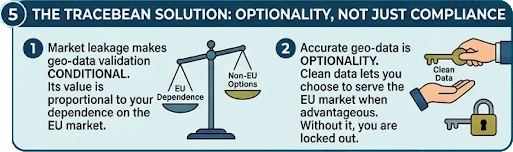
What doesn't change is the value of the data itself once a company decides EU access matters. Accurate, structurally valid geolocation isn't just a compliance cost — it's optionality. A company with clean geo-data can choose to serve the EU market when it's advantageous to do so. A company without it has already made that decision for itself, whether or not it meant to.
We don't have a way to close the market-leakage gap — that's a matter of global regulatory coordination, well outside what geo-data validation can fix on its own. What we can do is make sure that when a company decides the EU market is worth the effort, the data behind that decision is ready rather than a six-month scramble.
Compliance readiness isn't about market share today. It's about not being locked out of a market later because the groundwork was never laid.
Trade-diversion research is drawn from a ScienceDirect assessment of EU-China policy convergence on imported deforestation (2024), citing Meyfroidt et al. (2010), Bastos Lima et al. (2019), Bager et al. (2021), Brandt et al. (2022), Drost et al. (2022) and Köthke et al. (2023), alongside historical tropical-timber diversion research by Giurca et al. (2013) and Masiero et al. (2015). The wood pellet trade model is drawn from a ScienceDirect spatial equilibrium study (March 2025). Price-differential reporting is drawn from Fastmarkets (September 2025). The Nigerian cocoa case is drawn from Reuters, "West Africa cocoa sector struggles to meet EU anti-deforestation rules, raising supply concerns" (Ben Ezeamalu and May Angel, 17 August 2026). The Brazilian rancher quote is drawn from g1 Globo, "UE compra pouco da carne bovina do Brasil, mas paga mais e abre portas para outros mercados" (Paula Salati, 3 August 2026) — reporting on a separate EU antimicrobial-use measure, cited here only for the compliance-incentive dynamic it illustrates, not as an EUDR-related case. US trade exposure figures are drawn from the American Farm Bureau Federation's Market Intel analysis (December 2025).
← Back to Blog