
We've profiled coffee and cocoa so far in this series. Rubber is a different kind of case — not because the trade numbers are smaller, but because the underlying data problem isn't primarily about bad coordinates. It's about a satellite genuinely struggling to tell a rubber plantation apart from the forest around it.
The commodity that almost wasn't included
When the European Commission first drafted what became EUDR, natural rubber wasn't on the list. Early Commission research concluded it wasn't a significant enough deforestation driver to warrant inclusion alongside palm oil and soy. EU environment ministers reconsidered, and rubber was added before the regulation's final text.
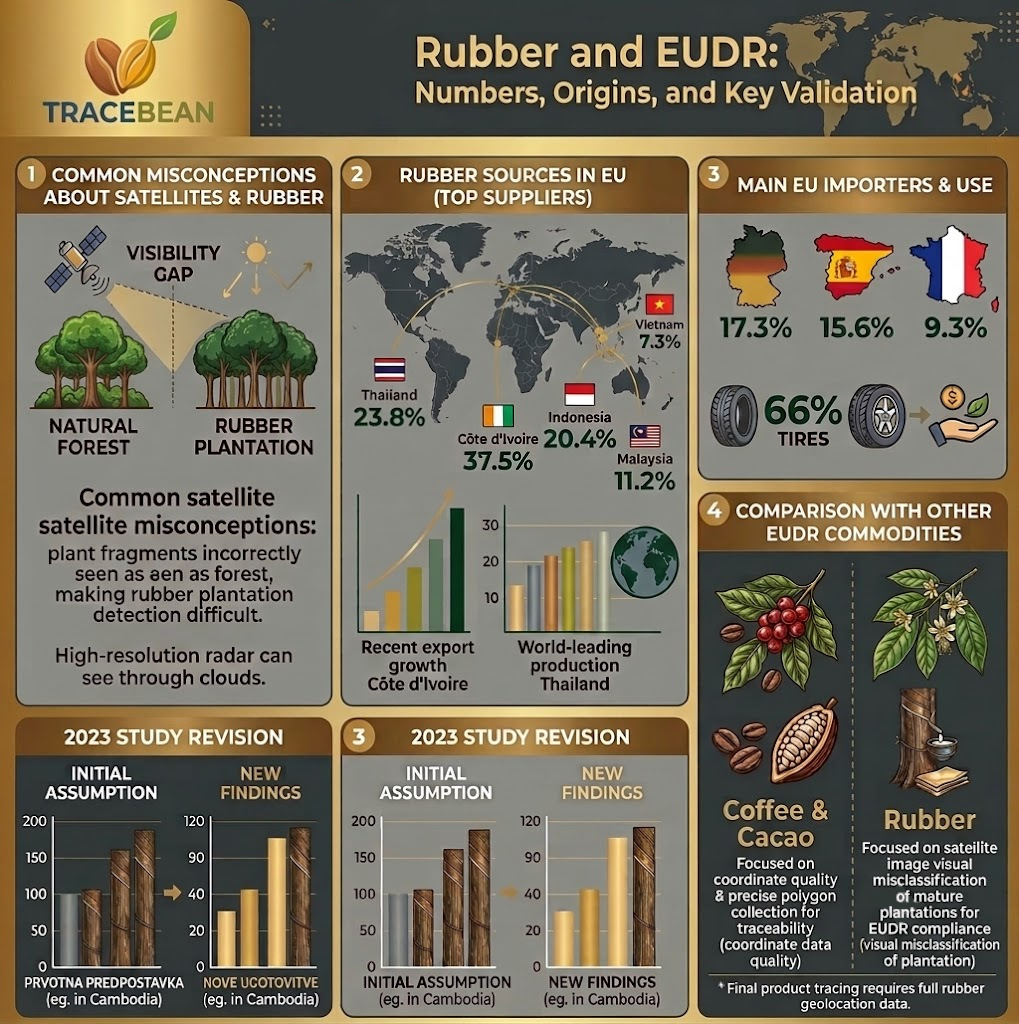
That call looks more justified in hindsight than it did at the time. A 2023 remote-sensing study — using high-resolution imagery specifically built to see through the cloud cover that obscures most tropical rubber regions — found that rubber cultivation drives at least twice as much deforestation as the data underpinning EU and G7 policy had assumed. In Cambodia, the same research linked over 40% of rubber plantations to deforestation, nearly a fifth of it inside key biodiversity areas.
Why rubber is hard to see, specifically
Standard satellite classification struggles with rubber for a structural reason, not a data-quality one: rubber trees form a closed canopy that looks a great deal like the natural forest it's often planted near or instead of. Add persistent cloud cover across Southeast Asia's rubber belt, and even well-resourced monitoring systems have historically undercounted rubber-driven forest loss — which is exactly why the 2023 findings came as a correction to prior assumptions, not a confirmation of them.
We've written before about the closely related problem with shade-grown coffee being misclassified as forest. Rubber has a version of the same failure mode, but structural to the entire crop rather than a subset of production methods — tree cover that looks like forest because, visually, it largely is one.
Where the EU's rubber actually comes from
The top five non-EU suppliers together account for the large majority of the EU's natural rubber imports, with the top ten covering 98%. Southeast Asia supplies about 65%, West and Central Africa the remaining 35%.
Côte d'Ivoire's position at the top is a recent shift — its EU exports of natural rubber grew from roughly €618 million in 2024 to over €834 million in 2025, even as Thailand remains the world's largest overall producer by a wide margin.
Who in the EU imports it
Consumption concentrates in the countries with the largest tire industries: Germany leads at around 17.3% of EU natural rubber consumption (home to Continental), followed by Spain at 15.6% and France at 9.3% (home to Michelin). Roughly two-thirds of everything the EU imports ends up in tires, with the remainder going to industrial parts, footwear, gloves and adhesives.
A different kind of fragmentation than coffee or cocoa
Coffee had Brazil as a partial exception to smallholder dominance. Cocoa had no exception at all. Rubber sits closer to cocoa's pattern but for a different reason: an estimated 85% of global natural rubber comes from smallholders on plots typically under five hectares — in Thailand alone, around 1.7 million smallholders produce 90% of the country's supply.
There's a genuinely positive angle worth including here. The Global Platform for Sustainable Natural Rubber notes that, for many smallholders, EUDR's geolocation requirement is the first time they'll have an actual map of their own plantation — land tenure and legal recognition benefits that exist independent of EU compliance.
With coffee and cocoa, the question is usually whether the coordinates are correct. With rubber, coordinates can be perfectly correct and still sit inside a forest-loss signal that can't reliably tell a rubber canopy from the forest next to it.
Where this leaves the fit assessment
Geo-data validation still matters here — a wrong coordinate is a wrong coordinate regardless of what's growing on the plot, and the smallholder-heavy origins (Thailand, Indonesia, parts of Côte d'Ivoire) carry the same collection and format problems as smallholder coffee and cocoa. But rubber makes a case we haven't had to make as directly with the first two commodities in this series: geometric correctness is necessary and not sufficient. A structurally valid polygon sitting inside a satellite misclassification is still a false positive waiting to cost someone a shipment.
For rubber specifically, geometry validation is the first, necessary layer — not the whole answer. A correctly formatted polygon still needs a deforestation signal capable of distinguishing a rubber canopy from the forest it resembles, which is a harder problem than the geometry check alone solves.
Next in this series: palm oil and soy — where, unlike rubber, the honest answer may be that the geo-data problem is smaller than the regulation's attention to these commodities would suggest.
Deforestation figures are drawn from Wang et al. (2023), "Rubber plantation expansion related deforestation loss and its socio-ecological impacts," and related Carbon Brief and RFA coverage. Trade figures are drawn from UN Comtrade / World Bank WITS (2024–2025), the European Coffee Federation's ECF Pilot Report on natural rubber (AidEnvironment, June 2024), and France's Stratégie nationale de lutte contre la déforestation importée. Smallholder figures are drawn from Mongabay (June 2026) and the Global Platform for Sustainable Natural Rubber (GPSNR).
← Back to Blog