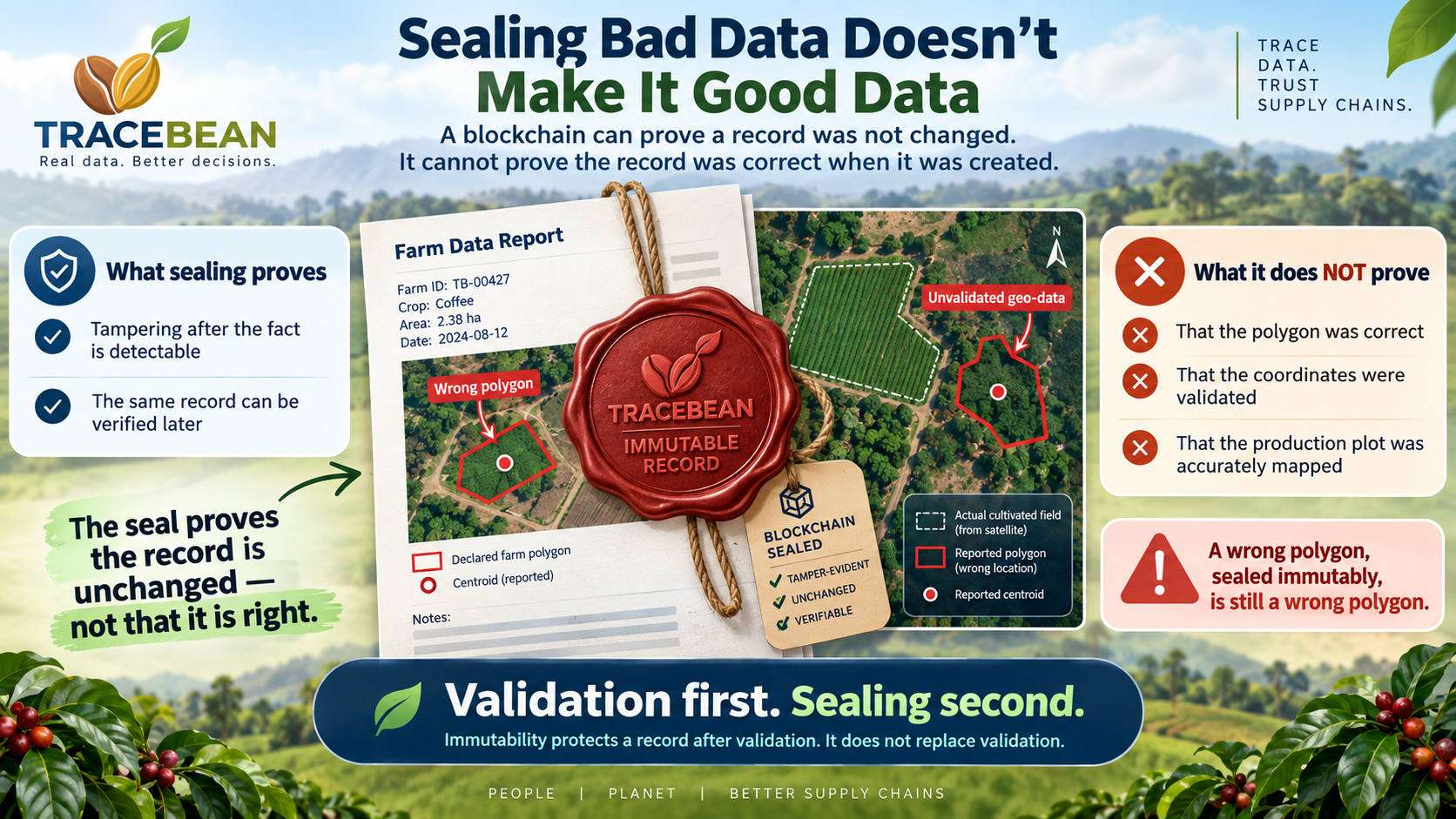
A platform maps a polygon over satellite imagery, signs the boundary, and locks the result on-chain. From that moment forward, nobody — not the operator, not a regulator, not the platform itself — can alter that record without it being detectable. That's a real, useful property. It's also being sold, increasingly, as something closer to a compliance guarantee than what it actually is: proof that a piece of data has not changed, with no claim at all about whether that data was correct to begin with.
Two different questions, wearing the same vocabulary
Has this specific record been altered since the moment it was written? A cryptographic hash, anchored publicly, makes tampering after the fact detectable — by anyone, without needing to trust the platform's own word for it.
Was the polygon correct when it was drawn? Does it describe the actual production plot, in the right coordinate system, without self-intersection or duplication? Sealing a record settles none of this — it only freezes whatever was there.
These sound like they should be related, because both involve the word "proof." They aren't the same claim, and treating them as interchangeable is where this goes wrong. A wrong polygon, sealed immutably, is not a corrected polygon. It's a wrong polygon that is now provably, permanently, cryptographically the same wrong polygon it always was.
This isn't a hypothetical marketing risk
One certification-body owner, discussing this exact dynamic in a public EUDR forum recently, put the concern plainly: many advisors are telling importers they can solve their compliance problem with a blockchain system full of PDFs — as if locking a document in place were the same thing as making sure the document says something true. He wasn't naming a specific vendor. He didn't need to. It's a description that fits an entire emerging category: platforms built around Sentinel-2 imagery and on-chain notarisation, marketed explicitly as an "unchallengeable" shield for exactly this kind of due diligence — the tamper-evidence framed as the compliance answer, with the underlying data-quality question left conspicuously unaddressed.
Immutability is a promise about the future of a record. Accuracy is a claim about its past. A platform that only delivers the first while implying the second has sold half a guarantee as a whole one.
Where this actually bites
Picture a supplier's centroid that was never checked against a country boundary, never tested for a swapped latitude and longitude, never confirmed to sit on the correct side of a coordinate reference system conversion. Seal it on a blockchain today, and in five years it is exactly as wrong as it is today — except now it also carries a timestamp and a cryptographic signature that make it look like it survived scrutiny, when scrutiny is precisely what it never received. An auditor pulling that record won't see "unvalidated." They'll see "verified," because the two words have been allowed to mean the same thing in the interface, when they never meant the same thing at all.
What this means for how we think about our own reports
We've been asked, reasonably, whether TraceBean should timestamp its own PDF and GeoJSON outputs against something like a public blockchain — mainly to prove that a report wasn't quietly altered after we issued it. That's a legitimate, separate question from anything in this post, and the honest answer is: possibly, eventually, if a client ever actually needs that specific guarantee. But it would need to sit in exactly the right place in the sequence.
Sealing has to come after validation, never instead of it. Our correction and flagging logic exists to answer the question a seal cannot: is this geometry actually right. Only once that question has been answered — corrected where possible, flagged where not — does it make sense to ask a second, entirely different question: can we now prove nobody quietly edited the answer afterward. Reversing that order doesn't strengthen a report. It just makes an unverified claim harder to walk back.
The two problems are genuinely solvable, and there's no need to pretend blockchain solves neither of them. It solves one, cleanly. The other one — whether the coordinates were ever right — still has to be done first, by something that actually looks at the geometry. No amount of cryptography substitutes for that step. It only decides how convincingly the result of skipping it gets remembered.
General claims about blockchain-sealed satellite evidence in this post refer to marketing language publicly available on vendor websites in this category, not any single named product. The observation about advisors positioning blockchain-plus-documents as a compliance solution was made publicly by a certification-body professional in an EUDR-focused LinkedIn discussion, quoted here in substance rather than verbatim.
← Back to Blog