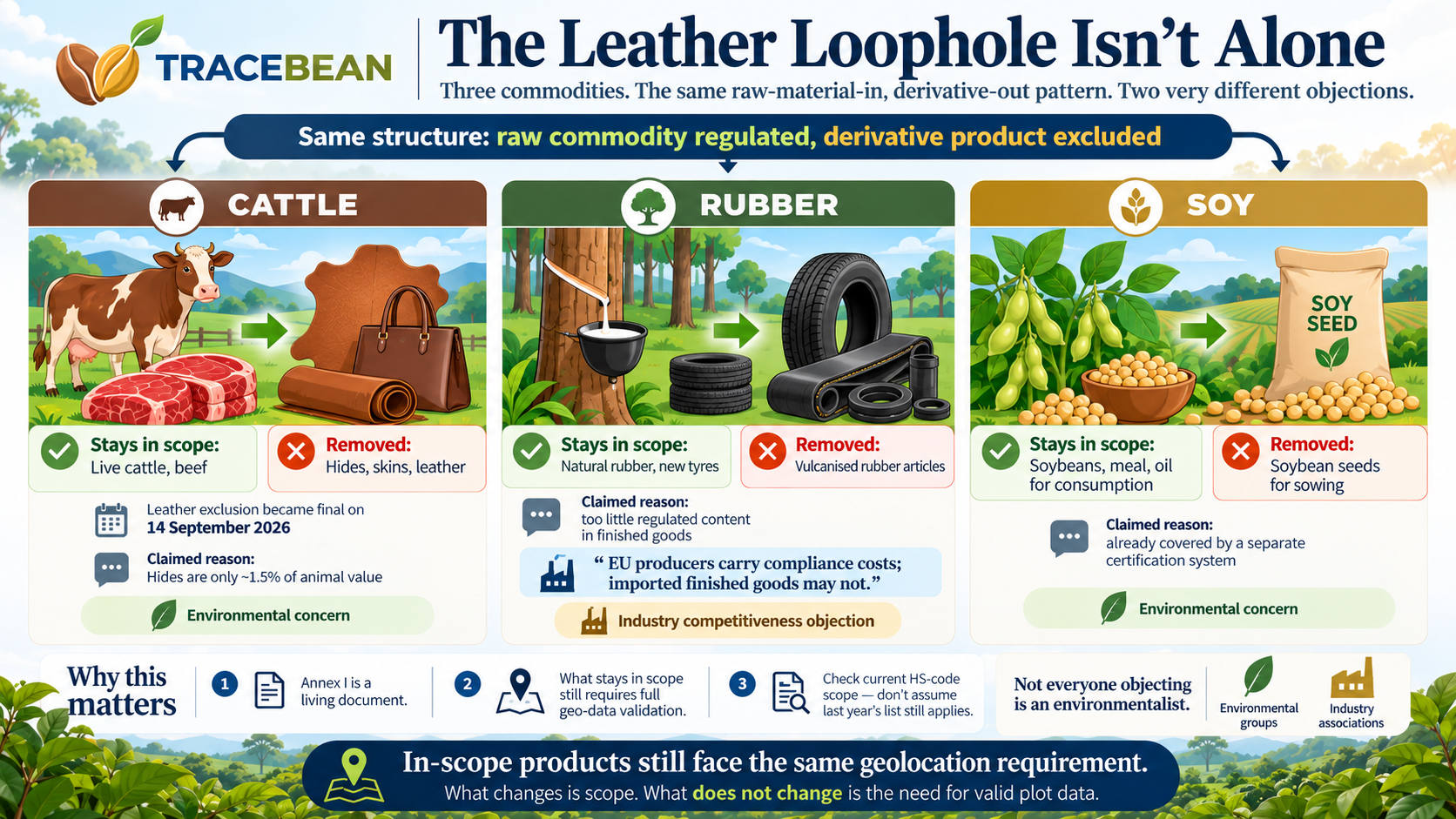
On 14 September 2026, the two-month scrutiny window on the EUDR's leather exclusion closed without a single objection from Parliament or the Council. The delegated act is now, definitively, law. Cattle hides, tanned hides, and finished leather — HS codes 4101, 4104, and 4107 — are out of Annex I. We wrote about the fight over this back in early September, when the outcome still depended on a vote that hadn't happened. It has happened now, and the closure is worth returning to — not because the outcome changed, but because two things came into focus that weren't fully visible while the fight was still live.
What became official, and what the Commission admitted along the way
The industry's winning argument rested on a single number: raw hides account for roughly 1.5% of a bovine's total value at the abattoir, according to 2026 UNIDO guidelines cited approvingly by trade groups after the vote. Too small a share, the reasoning goes, to give tanneries meaningful leverage over their cattle suppliers' land-use practices.
What's harder to square is that the Commission's own staff working document, prepared to support this exact proposal, estimated leather's associated deforestation footprint at up to 390 square kilometres a year — roughly twice the size of Pisa. The document didn't dispute the environmental link. It concluded that requiring compliance anyway would impose costs the sector wasn't economically positioned to absorb. The exclusion isn't a finding that leather is clean. It's a finding that making it prove otherwise wasn't judged worth the friction.
Where the risk actually sits
Two documented cases give this some shape. Global Witness traced hides bought by an LVMH-owned tannery group to two South American beef suppliers linked to roughly 110,000 hectares of forest cleared in the Gran Chaco since 2021, on land belonging to the Ayoreo Totobiegosode indigenous people. Separately, an Earthsight investigation connected a European tannery supplying the luxury brand Coach to cattle ranching in the Amazon. Neither case depended on leather being harder to trace than beef — the underlying animal and the underlying land are identical. What differs is oversight: EU-bound beef supply chains pass through sanitary and veterinary inspection regimes that leather, as a non-food product, does not. That gap creates a documented pathway for hides from clandestine or under-inspected slaughterhouses to reach EU tanneries by a route the meat from the same animals couldn't take.
This isn't confined to South America. Industry commentary on the final rule explicitly frames it as relief for exporters well beyond Brazil and Paraguay — Indian and other global small and medium leather exporters are named directly as beneficiaries of the reduced compliance burden. The mechanism travels wherever cattle and tanneries do.
The same shape, twice more, for two different reasons
The same 13 July delegated act that excluded leather made two other removals that follow an identical structure: the raw commodity stays regulated, a derivative product built from it exits scope.
| Commodity | Stays in scope | Removed from scope | Stated reason |
|---|---|---|---|
| Cattle | Live cattle, beef | Hides, skins, leather (HS 4101/4104/4107) | Hides are ~1.5% of animal value; low supplier leverage |
| Rubber | Natural rubber, new tyres (HS 4001, 4011) | Vulcanised rubber articles, conveyor belts (HS 4010/4016) | "Too little regulated content" in the finished product |
| Soy | Soybeans, meal, oil for consumption | Soybean seeds for sowing (HS 1201 90 00) | Seeds already run through a separate certification system |
Read as a set, this looks less like three isolated lobbying wins and more like a structural feature of how the delegated act mechanism works: Annex I is a list of Combined Nomenclature codes, and a persuasive enough argument that one code contains "too little" of a regulated commodity is, procedurally, all it takes to remove it — regardless of which commodity or which industry is asking.
The objection nobody expected to come from an industry association
The leather and soybean-seed removals drew criticism from the sources you'd predict — IATP, Mighty Earth, Canopée, environmental researchers arguing the science didn't support the carve-out. The rubber removal drew a genuinely different complaint, from a source with no environmental brief at all.
"The EU Commission is unnecessarily opening the door to the import of comparable finished goods from China and other third countries... The Commission is thus creating a regulatory one-way street. Those who produce in Europe bear the costs of deforestation-free raw material supply chains. Anyone who imports the finished product from outside Europe should be spared these requirements."
— Michael Klein, President, WDK (German Rubber Industry Association), 15 July 2026
Klein's objection has nothing to do with whether vulcanised rubber articles are linked to deforestation. It's a competitiveness argument: a European manufacturer that processes natural rubber into a finished belt or gasket still carries the full compliance burden of proving that rubber deforestation-free. A manufacturer in China or elsewhere that makes the identical finished part and ships it into the EU carries none, because the finished-goods HS code is no longer listed. The raw material is policed. The imported finished product, made from the same raw material, isn't. WDK called this a standard applied unevenly depending on where the last manufacturing step happens — not an environmental complaint, a trade-fairness one, and arguably a harder one to dismiss, because it doesn't require taking a position on deforestation science at all.
Three commodities, the same structural loophole, and two entirely different reasons to be unhappy about it. One says the exclusion lets real environmental harm through the back door. The other says it doesn't matter whether harm gets through — it matters that European producers pay for prevention while their overseas competitors don't have to.
What this means for the geo-data underneath it
None of this changes how we validate a plot's geometry once a commodity is actually in scope — a coffee or cocoa polygon is checked the same way regardless of which HS codes moved in or out of Annex I this year. What it does mean is that Annex I is now a demonstrably living document, amended twice in eight months, on a mechanism that can remove a derivative product from scope without reopening the regulation at all. An operator whose product sits close to one of these boundary lines — a rubber component that's mostly-but-not-entirely natural rubber, a soy product that could be classified as seed or as meal — has a real reason to check the current HS code list before assuming last year's scope still applies. The geolocation requirement for whatever remains in scope hasn't softened once. What counts as "in scope" keeps moving, and it's worth checking rather than assuming.
Sources: UNIDO Guidelines for Assessing the Environmental Footprint of Leather (2026); European Commission Staff Working Document accompanying the Annex I Delegated Act, as reported by Mongabay (May 2026); Global Witness investigation into Nuti Ivo, Minerva Foods, and Frigorífico Concepción (2026); Earthsight investigation into Coach's leather supply chain (2025); WDK statement, 15 July 2026, as reported by European Rubber Journal; Commission Implementing Regulation (EU) 2026/1565 and the 13 July 2026 Annex I Delegated Act.
← Back to Blog