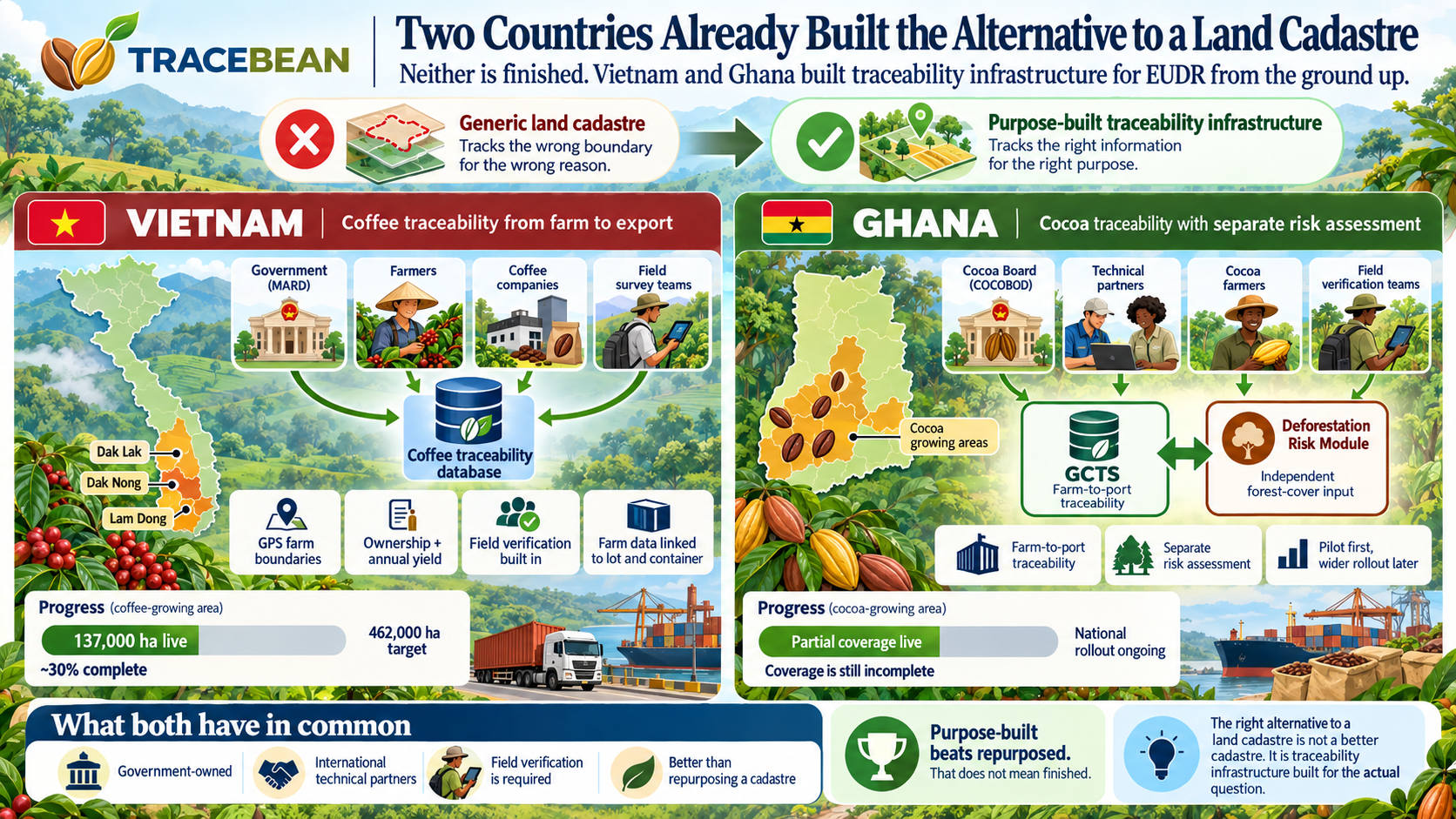
We've spent a few posts making the case that a country's general land cadastre is the wrong tool for EUDR geolocation — it tracks property boundaries, not production plots, and it's frequently self-declared rather than surveyed. What we haven't covered is what a right-shaped alternative actually looks like when someone builds one on purpose. Two countries have, and the honest version of their story includes exactly how much of the job still isn't done.
Vietnam: a database built for coffee, not for land in general
On 17 December 2024, Vietnam's Ministry of Agriculture and Rural Development, the sustainable trade organisation IDH, and coffee roaster JDE Peet's launched the Database System for Forest and Coffee Growing Areas — built from land-use planning maps, cadastral records, and production-area data pulled from provincial agencies, coffee enterprises, and farmers themselves, then checked against field surveys specifically to catch and correct discrepancies before the data went live.
| Component | What it covers |
|---|---|
| MARD national database | GPS farm boundaries, ownership records, annual yield — 137,000 ha enrolled, expanding toward a 462,000 ha target |
| Regional monitoring | Active specifically in Đắk Lắk, Lâm Đồng, Đắk Nông — provinces with farms near or inside forest boundaries |
| Exporter lot coding | Links GPS farm data to processing lot and shipping container |
The design choice worth noticing: field verification isn't a one-time validation step bolted on afterward. It's built into how the dataset gets assembled in the first place, specifically to reconcile the paperwork against what's actually on the ground before anyone treats it as reliable.
Ghana: two systems, one problem, split deliberately
Ghana's Cocoa Board built the Ghana Cocoa Traceability System (GCTS) with technical support from Germany's GIZ, tracking cocoa from farm to export port, piloted first in three districts (Assin Fosu, Assin Breku, New Edubiase) before wider rollout. Deliberately separate from it: a Deforestation Risk Assessment Module, developed with the European Forest Institute, built specifically to flag whether a given plot was converted after the EUDR's cut-off date — and a 2020 forest cover map from Ghana's Forestry Commission, built to the FAO's forest definition and independently validated by a university (KNUST), not just by the cocoa board that has a commercial stake in the answer.
That last detail matters more than it looks. Keeping the forest-cover assessment institutionally separate from the traceability system that tracks commercial cocoa volumes is a structural choice against exactly the kind of self-marking we've criticised in less careful designs elsewhere on this blog.
Neither system is finished, and that's the part worth saying plainly
Vietnam's own numbers say it: 137,000 of a targeted 462,000 hectares enrolled, meaning under a third of the intended coverage is live so far. Industry commentary on the ground is direct about what that gap means in practice — plot-level traceability and land legality verification across fragmented smallholder networks remains the main unresolved challenge, and third-party platforms are still being deployed specifically to bridge it.
An independent academic gap analysis of Ghana's system found the same shape of problem: traceability gaps persist at several nodes in the chain, and the cocoa board's own management system doesn't yet operate at full farm-plot resolution everywhere it needs to.
Purpose-built beats repurposed. It doesn't mean finished. A national system still covering a third of its target hectares is real infrastructure and an unfinished project at the same time — both things are true, and reporting only one of them would be dishonest in different directions.
What both have in common, structurally
Government ownership, an international technical or funding partner (GIZ, IDH, EFI), and field verification treated as a required step rather than an optional add-on. Neither country tried to stretch an existing administrative dataset to cover a job it wasn't built for. Both accepted that a purpose-built system, even an incomplete one, beats a repurposed one that covers 100% of the country with the wrong definition of a plot.
If a system like Vietnam's or Ghana's eventually reaches full coverage, with an accessible, independently verified data feed, it becomes a genuinely interesting future input alongside what a supplier submits directly — a second, government-backed reference point to validate against, not unlike how we already check a corrected coordinate against a country boundary. That's not something we're building. Vietnam's platform is at roughly 30% of its own target coverage, and we have no confirmed customer whose supply chain runs through provinces where either system already operates end to end. Worth tracking closely. Not worth a line of code before someone actually needs it.
What's clear already, without waiting for either system to finish: the industry's own answer to "what beats a land cadastre" isn't a better cadastre. It's infrastructure built for the specific question EUDR is actually asking, with the people checking it having no commercial reason to prefer one answer over another.
Sources: IDH, "Vietnam's Coffee Sector Marks a Landmark Step" (December 2024); Comunicaffe International and CoffeeTalk, launch coverage of the MARD-IDH-JDE Peet's Database System for Forest and Coffee Growing Areas; Tám Trình Coffee, Vietnam traceability system status (2026); AgNavigator / Koltiva, "Land Legality and Plot-Level Traceability Challenge Vietnam's Coffee Sector Under EUDR" (February 2026); European Forest Institute, EUDR Technical Workshop Report (2024); GBC Ghana Online, "Ghana Positions Cocoa Sector for Full Compliance with EU Deforestation Regulation" (2026); zerodeforestationhub.eu, "Preparedness Check of Ghana for the EU Deforestation Regulation"; academic framework analysis, "Traceability Gaps and Digital Compliance Readiness in Ghana's Cocoa Supply Chain."
← Back to Blog