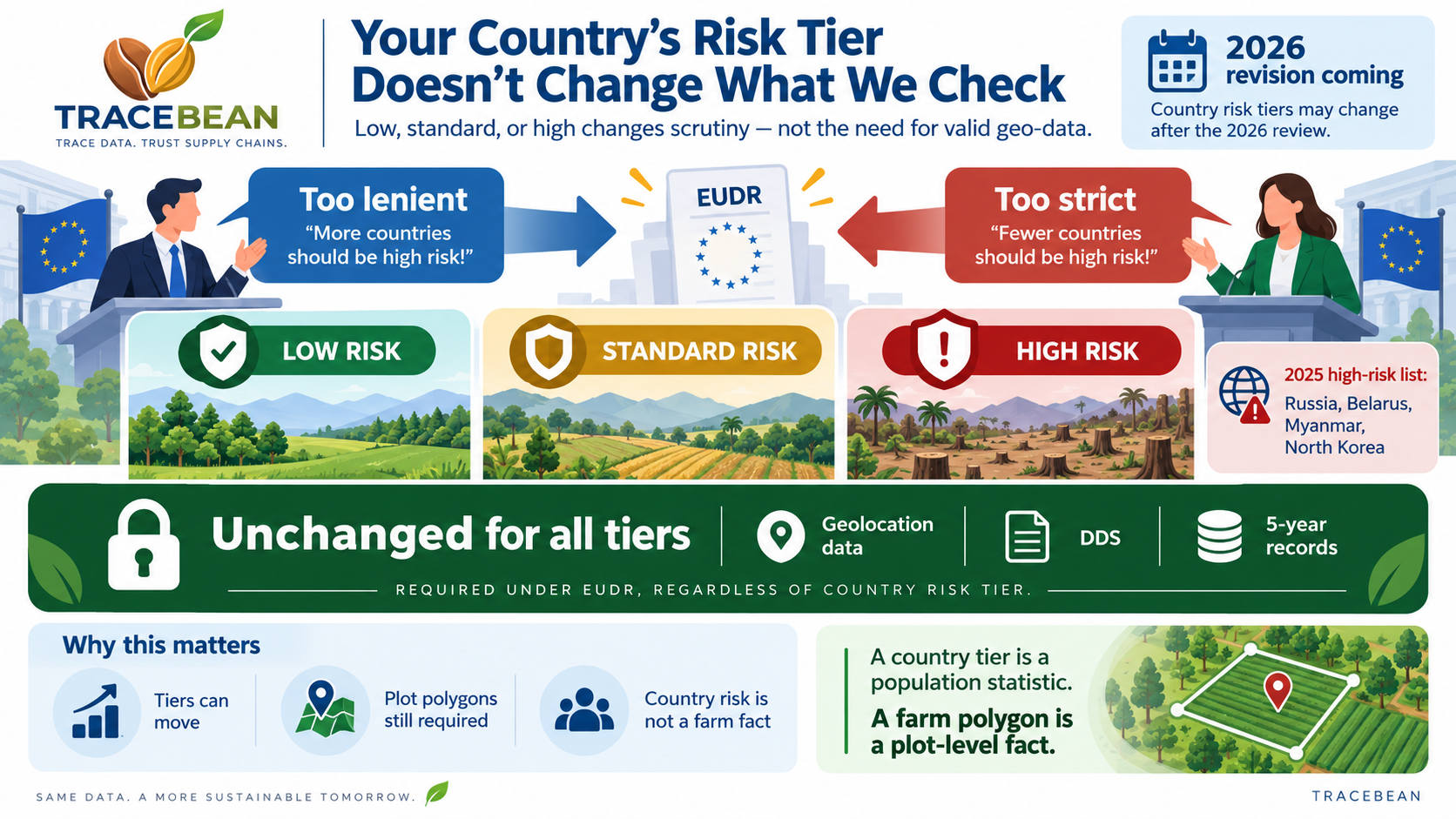
In May 2025, the European Commission published its long-awaited country risk classification under EUDR: 194 countries, sorted into low, standard, and high risk across all seven regulated commodities. It was meant to settle a question. Instead, it started an argument that two opposing sides are still having, and a company that built its compliance planning around a specific tier assignment is standing on ground that could shift under it before this is over.
Only four countries made the "high risk" list — and they were an easy call
Russia, Belarus, Myanmar, North Korea. All four were already under EU Council sanctions for reasons that have nothing to do with deforestation. Naming them "high risk" carried no diplomatic cost, because the diplomatic cost had already been paid.
Everything else — including countries with long-documented forest governance problems — landed in "standard" or "low."
The case that makes the methodology hard to defend
| Country | EC benchmark (2025) | Forest Trends IDAT Risk |
|---|---|---|
| Republic of the Congo | Low risk | High risk |
| Central African Republic | Low risk | Elevated concern |
| Turkey | Low risk | Flagged for laundering |
| Kazakhstan | Low risk | Flagged for laundering |
Forest Trends, a research organisation that has been building deforestation risk indices since 2017, rates the Republic of the Congo as high risk — not on a hunch, but on World Bank fragile-state indicators and a documented 150% surge in forest loss during 2024, driven largely by illegal logging. The EC's own benchmark, built mostly from historical deforestation rates and existing political sanctions rather than governance or corruption data, calls it low risk.
The sharper problem: Turkey and Kazakhstan are also rated low risk under the EC benchmark — and the European Commission is, at the same time, actively investigating both countries for laundering banned Russian-origin birch plywood into the EU. The regulator's own enforcement arm and its own risk classification are pointing in opposite directions about the same two countries.
And then the other side objected — for the opposite reason
In July 2025, the European Parliament passed a formal, non-binding resolution objecting to the benchmarking methodology. The push didn't come from groups arguing the list was too lenient. It was led by the EPP, arguing the opposite: that three tiers weren't nuanced enough, and that a fourth category — something like "zero risk" or "insignificant risk" — should exist for countries such as Austria, where forest cover is expanding rather than shrinking.
So the same classification system is simultaneously criticised for being too soft on countries with real governance problems, and too harsh on countries with genuinely low deforestation rates. Both critiques can't be fully right, but both are being made in earnest by people with real standing in this debate — which is itself a sign of how unsettled the methodology is.
A list that draws formal objections from both directions at once isn't a list anyone should treat as a stable foundation for long-term planning.
The Commission has already committed to changing it
None of this forced an immediate change. The resolution wasn't binding, and the existing classifications — Implementing Regulation (EU) 2025/1093 — remain legally in force. But the Commission committed to a first revision in 2026, and industry compliance commentary has been consistent on what that means in practice: countries could move tiers, possibly significantly, and companies that built their due diligence resourcing around today's classification for a given origin may need to redo that work when the tiers shift.
What has not moved, through any of this
Regardless of which tier a country sits in — low, standard, or high, today or after the 2026 revision — the geolocation data, the due diligence statement, and the five-year record-keeping requirement apply identically. The risk tier changes how intensively an authority is expected to scrutinise a shipment and how much risk-assessment documentation an operator has to produce around it. It has never changed whether geolocation is required in the first place.
This is easy to lose sight of, because "low risk" reads like "less to do." For the risk-assessment paperwork, that's accurate. For the underlying geo-data, it isn't. A "low risk" cocoa shipment from a country that gets reclassified in 2026 still needs the same valid, correctly-projected, properly-closed polygon it needed the day before the reclassification — the plot didn't change, only the paperwork tier around it did.
Every validation report we produce works at the level of the individual plot — geometry, coordinate system, boundary integrity — independent of whatever tier the country sits in this year. That's not a design choice made in response to this controversy; it's the same discipline we've written about before, applied one level up. A country's risk classification is a statistic about a population. It was never a fact about one farm's polygon, and it still isn't, no matter which way the 2026 revision goes.
One idea we're turning over, not yet built: reporting a shipment's official EC tier alongside how an independent index like Forest Trends' IDAT Risk rates the same origin, purely as context — not a verdict, just the two numbers side by side where they diverge. Worth doing if it turns out to be useful to the people actually reading these reports; not worth promising until it is.
The safest planning assumption right now isn't "my origin is low risk, so this is simple." It's "the tier is provisional, the geolocation requirement is not" — and building geo-data practices around the second half of that sentence is the only version of this that survives whatever the 2026 review decides.
Sources: Canby, K. & Walkins, M., "EUDR Country Benchmarking Misses the Mark," Forest Trends, May 2025; Preferred by Nature, "Making Sense of the EU Parliament Objection to EUDR Country Benchmarks," July 2025; ESG Today, "EU Lawmakers Reject EUDR's Country Risk System in New Setback to Deforestation Regulation," July 2025; Commission Implementing Regulation (EU) 2025/1093.
← Back to Blog