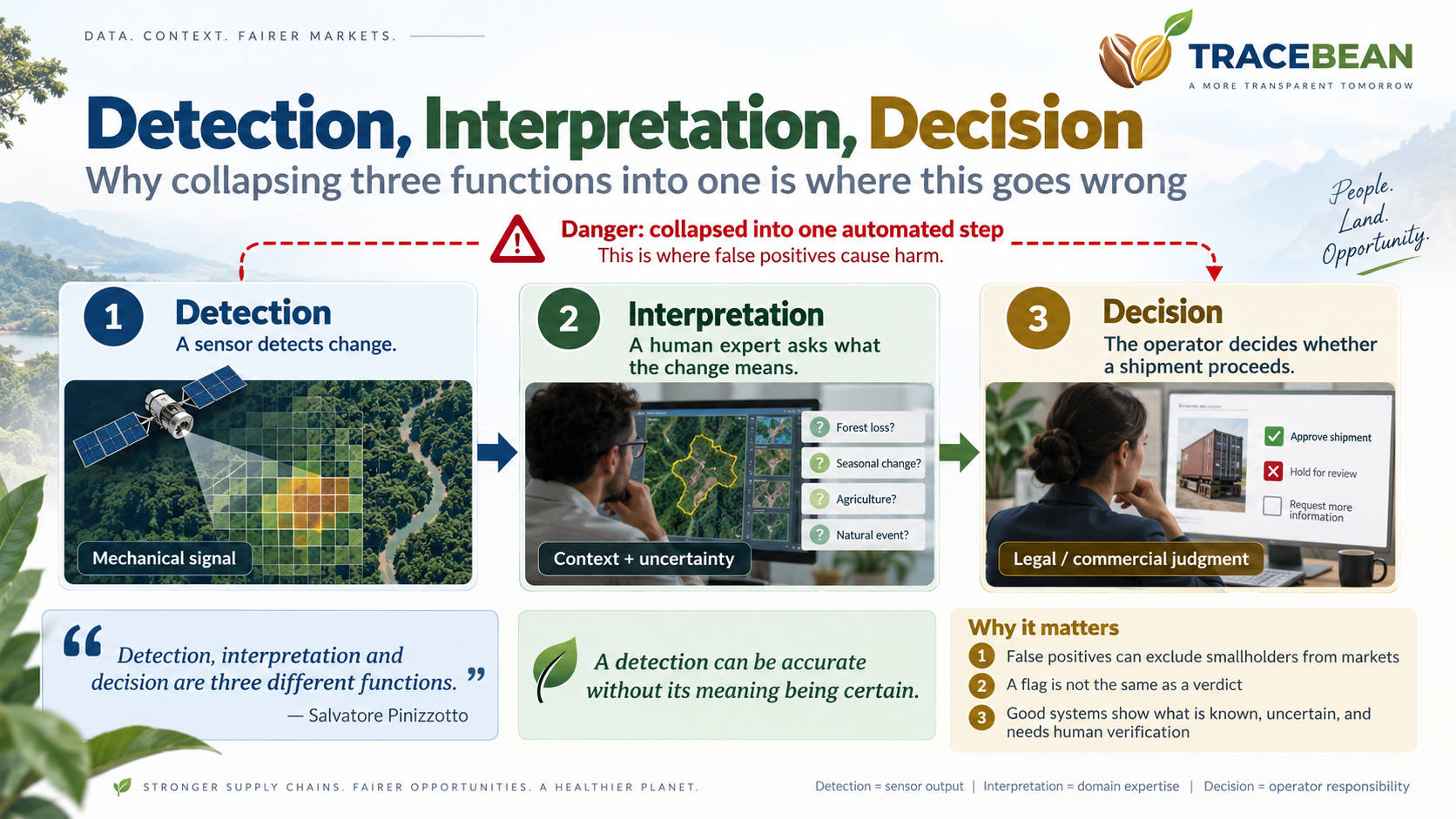
We wrote a comment thread's worth of this argument before we wrote this post. A conversation under one of our LinkedIn posts, with Salvatore Pinizzotto, a strategic intelligence and industrial-systems consultant, ended up naming something we'd been building around by instinct without ever stating it this cleanly.
The framing, in his words
"Detection, interpretation and decision are three different functions. Problems arise when we collapse them into one automated step. A good system should therefore be able to say not only 'something has been detected', but also 'this is what we know, this is what remains uncertain, and this is what requires human verification.'"
— Salvatore Pinizzotto, Strategic Intelligence & Industrial-Systems Consultant, in a LinkedIn exchange, August 2026
He added the sentence that actually raises the stakes: "That architecture becomes especially important when the cost of a false positive is not merely technical, it can determine whether a smallholder remains connected to a market." A false positive in most software is an inconvenience. A false positive in a deforestation risk screen can be a livelihood.
Three jobs, not two
We've written before about keeping geometry facts separate from deforestation risk signals — never letting a tool render a compliance verdict it isn't entitled to make. Salvatore's framing is a useful correction to how we'd been describing that: it isn't really two functions, it's three.
Most of the frustration with automated screening traces back to exactly this collapse: a detection gets treated as a decision because nothing in the interface forces the intermediate step — interpretation — to stay visible. Skip step two, and step one silently becomes step three. The pixel changed colour, therefore the shipment is risky, therefore the farmer doesn't get paid this season. Nobody decided that chain explicitly. It happened because the system had no place to put "we don't know yet."
Where this actually costs someone something
This isn't a hypothetical harm. Research on smallholder participation in zero-deforestation commitments — most thoroughly documented in Indonesia's independent oil palm sector — has found that smallholders are consistently underrepresented among producers who successfully demonstrate compliance, in part because buyers facing ambiguous risk signals default to the safer commercial choice: sourcing from someone else. The mechanism isn't malice. It's a system that surfaced a flag with no attached context, handed to a buyer with no time to investigate it, who made the only decision available under uncertainty — walk away from the smallholder rather than the larger, better-documented supplier.
A large plantation with an in-house GIS team can absorb a false-positive flag: dispute it, supply supplementary evidence, get someone on a call. A smallholder cooperative usually cannot. The cost of collapsing detection into decision isn't distributed evenly — it lands hardest on exactly the producers EUDR's own smallholder provisions were written to protect.
This is bigger than EUDR, and the EU's own AI rules gesture at it
Article 14 of the EU AI Act — which applies to AI systems classified as high-risk under a separate, specific list of use cases that doesn't currently include deforestation-risk screening — requires that people overseeing such systems be able to "correctly interpret the... system's output" and stay alert to "automation bias": the tendency to over-rely on an automated result precisely because it arrived with the appearance of certainty. We're not claiming that requirement applies to geo-data validation tools today — it doesn't, as the rule is currently scoped. But the principle it's built on is the same one Salvatore named in a comment thread: a system that produces a confident-looking output is not the same thing as a system that has actually reasoned about that output, and treating the two as equivalent is where automated tools cause harm that has nothing to do with whether their underlying detection was accurate.
A detection can be accurate without its meaning being certain. What goes missing isn't the accuracy — it's the space between "something changed" and "here's what we don't yet know about why."
What this looks like when it's done honestly
Every validation report we produce carries this distinction structurally, not just as a disclaimer. A Hansen tree-cover-loss pixel is reported as detection: something changed, at this location, after this date. Alongside it, the report lists known interpretation hazards specific to the commodity — shade-pruning and stumping in coffee and cacao, cloud-cover artefacts, edge effects at 30-metre resolution — not to resolve the ambiguity, but to make sure whoever reads the report knows the ambiguity exists before they act on it. The decision — does this shipment proceed — is never rendered. It's the one function that has to stay entirely outside the tool, because it's the one function the tool has no legitimate claim to.
We didn't arrive at this three-part shape by reading systems theory. We arrived at it by watching what goes wrong when a detection gets treated as a verdict — a shade-pruned coffee plot flagged as if it were clear-cut, an importer with no way to tell the difference, a supplier with no good way to contest it. Naming detection, interpretation, and decision as three separate jobs is just a more honest way of describing the discipline we'd already built the platform around.
The credit for saying it this clearly belongs to the conversation that prompted this post, not to us.
Salvatore Pinizzotto's framing is quoted with his permission from a public LinkedIn exchange, August 2026. Smallholder exclusion findings are drawn from research on independent oil palm smallholder participation in zero-deforestation supply chain initiatives (Elementa: Science of the Anthropocene) and related WRI and FAO commentary on smallholder data burden under emerging traceability regulation. EU AI Act references are to Article 14 (Human Oversight), Regulation (EU) 2024/1689.
← Back to Blog