What changed
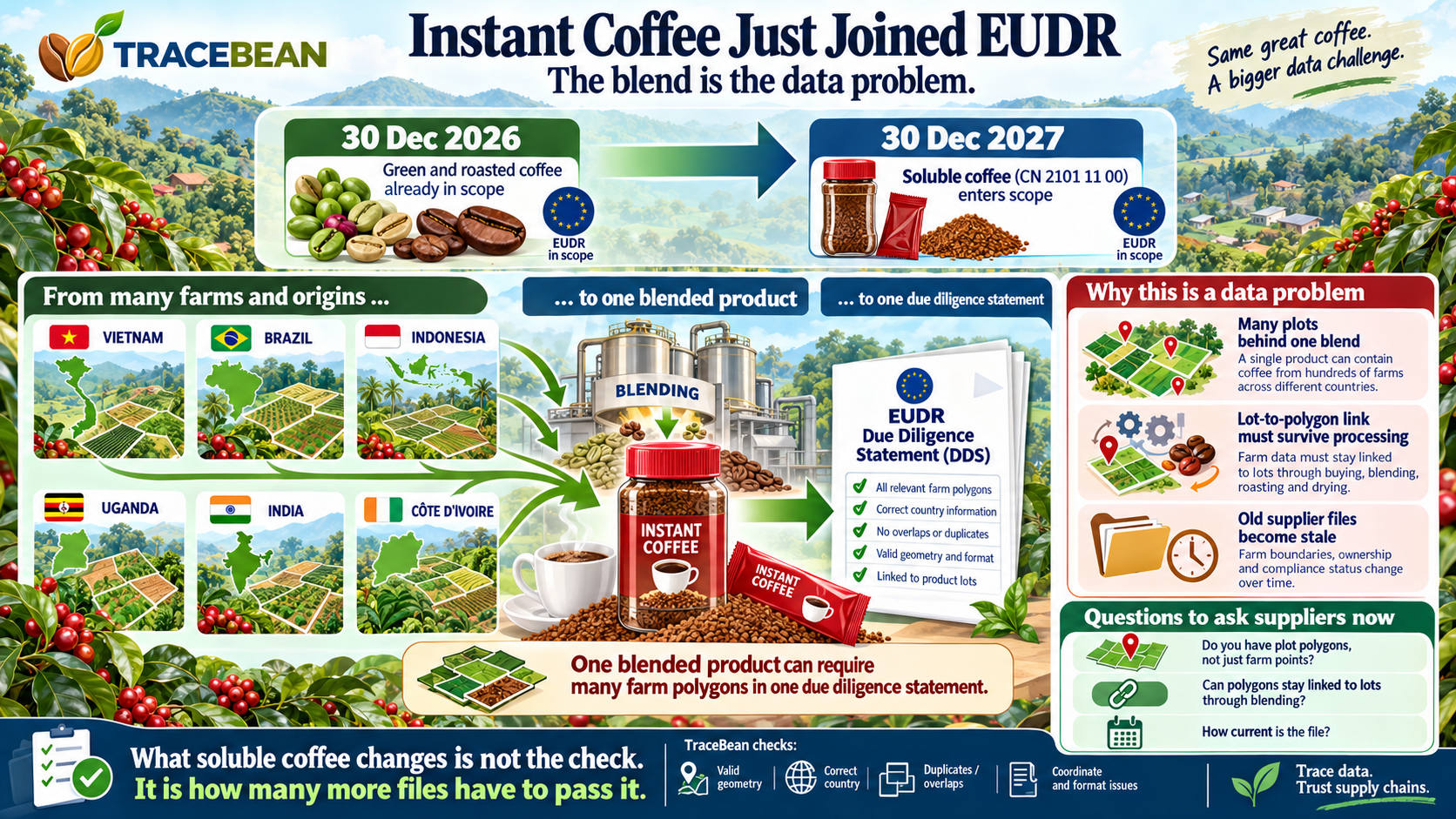
In July 2026 the Commission adopted a delegated act that rewrites the product list in EUDR Annex I. Most of the headline coverage went to what left the list, leather above all. A smaller line item went the other way: soluble coffee (CN 2101 11 00, extracts, essences and concentrates of coffee) is now in scope. The act, Commission Delegated Regulation (EU) 2026/2102 of 13 July 2026, entered into force on 18 September 2026.
Until now, green and roasted coffee were regulated and the instant coffee made from them was not. The Commission described that as a "fragmented and incoherent approach" that could push deforestation risk into more processed products. The European Coffee Federation had asked for the addition, citing fair competition inside the single market.
The gap was about where the coffee was processed. EUDR applies to products by customs code, not by ingredient: a product that is not listed in Annex I is out of scope even if it is made entirely from coffee. Instant coffee made in the EU from imported green beans was never a loophole, because the beans were covered when they entered. Instant coffee made outside the EU and imported as a finished product was: the beans never crossed the border as green or roasted coffee, so no one had to say where they were grown.
The same act went the other way for rubber. Conveyor and transmission belts and other vulcanised rubber articles were taken off the list, while natural rubber itself stays in scope. As we read it, a belt made outside the EU and imported as a belt now has the same structure instant coffee used to have: the raw material is regulated, the finished article is not, and it makes no difference which rubber went into it. In one act, the Commission closed this gap for coffee and opened it for rubber. We wrote about the same pattern with leather in earlier posts.
One more detail is worth reading closely. The EU tariff splits heading 2101 in two: 2101 11 covers extracts, essences and concentrates, while 2101 12 covers preparations with a basis of those extracts or with a basis of coffee, further divided by milk fat, sugar and starch content. The act adds a single new coffee line to the Annex, 2101 11 00, and we did not find 2101 12 in it. Whether retail products such as 3-in-1 mixes fall under 2101 12, and therefore outside the Annex, is a classification question for a customs specialist. We would ask it before assuming that every form of instant coffee is now covered.
Why this is a data question, not a product-code question
Adding a CN code takes one line in an annex. Complying with it does not. EUDR's logic is that every polygon of land where the commodity was produced must be identifiable. The Commission's own FAQ is explicit that where a product is made from commodities grown on several plots, several polygons must be provided in one due diligence statement.
Instant coffee is a blended, industrially processed product, and robusta dominates the raw material. According to reporting in Daily Coffee News, six countries (Vietnam, Brazil, Indonesia, Uganda, India and Côte d'Ivoire) account for roughly 95% of the robusta used in soluble products. Robusta sourcing is also often smallholder sourcing. As we read it, that means the polygon data a processor needs sits several steps upstream of the processor: with the farmers, their cooperatives and the traders in between.
A product code can be added in a year. A clean, current polygon file for every farm behind a blend cannot be.
"2027" is closer than it sounds
Contracts for deliveries after 30 December 2027 will be negotiated before that date, not after it. Any supplier who cannot show plot-level data for the coffee in a blend will have that conversation during the buying cycle, not on the filing day.
There is also a signal about how enforcement will look. In September 2025 competent authorities from Belgium, France, Germany and the Netherlands ran a preparedness exercise focused specifically on the coffee sector, with the European Forest Institute. According to Mayer Brown's summary, the authorities expected a complete paper trail for each shipment, and many operators could not demonstrate traceability to geolocated plots. That is a description of green coffee. It is reasonable to expect the same questions to be asked of soluble coffee once it is in scope. That last step is our inference, not something the authorities have said.
Three questions to ask your soluble coffee suppliers now
- Do you hold plot polygons for the beans in this blend, or only farm points, cooperative names or a country of origin?
- Can those polygons stay linked to lots as the coffee is blended and processed, or does the link break at the factory gate?
- How old is the file? Farms change hands and supplier lists rotate. A file collected two years before filing does not describe today's supply chain.
None of these questions is specific to instant coffee. They are the same questions green coffee importers have been asking since the regulation was first drafted. What changes is the number of companies who now have to ask them.
TraceBean does not have anything instant-coffee-specific. The checks are the ones we already run on any supplier file: valid geometry, coordinates inside the stated country, duplicated or overlapping polygons, format and coordinate-system problems.
What soluble coffee changes is not the check. It is how many more files have to pass it.
Sources: European Commission, Commission updates product scope and tools to support EUDR (13 July 2026); Daily Coffee News, European Commission Adds Soluble Coffee to EUDR Product List (16 July 2026); Mayer Brown, Are Companies Ready for EUDR Enforcement? Dry Run Insights (June 2026); Commission FAQ on the implementation of the EUDR, version 5 (April 2026), question 1.14. Legal text: Commission Delegated Regulation (EU) 2026/2102 of 13 July 2026, EUR-Lex.
← Back to Blog