What actually changed
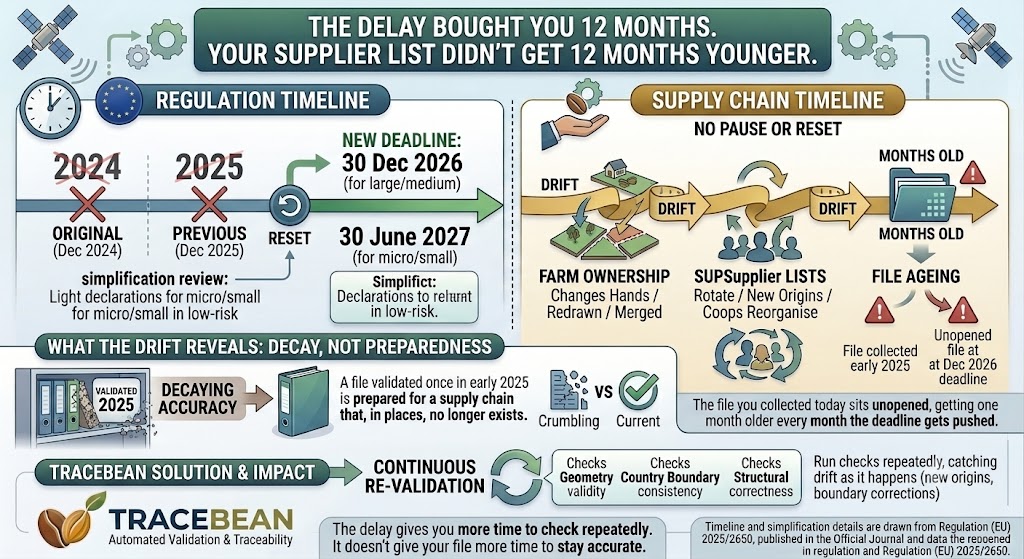
Regulation (EU) 2025/2650, published in the Official Journal in December 2025, postpones EUDR's main obligations by twelve months. Medium and large operators now have until 30 December 2026, up from December 2025. Micro and small operators move to 30 June 2027. This is the second postponement — the original December 2024 deadline was already pushed once, to December 2025, before this latest revision. The Commission also delivered a simplification review in spring 2026, which trims some obligations for downstream traders and introduces a lighter, one-off declaration for micro and small primary producers sourcing from low-risk countries.
That last point deserves a precise reading, not a broad one. The simplification applies to primary producers filing their own simplified declaration under the new annex — it does not change what a medium or large importer placing product on the EU market has to submit. If that's you, full due diligence, including plot-level geolocation, is still the requirement. The delay changed a date. It did not change what will eventually need to be true about your data.
The message you've already read three times
Open any compliance vendor's blog this month and you'll find close to the same paragraph: the extra year is not a reason to pause, keep building your systems now, don't let the delay become an excuse. It's good advice. It's also advice that every EUDR platform has an obvious commercial reason to give you, and by now most operators in this space have read a version of it more than once. Repeating it again wouldn't tell you anything you don't already know.
What's missing from that message is a reason. "Don't get complacent" is a warning about attitude. It doesn't explain what's actually accumulating while you wait — and that's the part worth spelling out, because it's specific to the kind of data TraceBean works with, not to compliance software in general.
What the delay doesn't pause
A due diligence obligation is a fixed target: a form, a system, a deadline. Supplier geo-data is not fixed. It moves continuously, independent of any regulatory calendar.
A geo-data file collected in early 2025, ahead of the original deadline, was never going to describe the same set of farms two postponements later. Some of those coordinates now belong to a different plot boundary. Some of those supplier relationships no longer exist. Waiting doesn't preserve a file's accuracy — it just delays the moment you discover how much of it has drifted.
The regulation's countdown reset. Your suppliers' farms did not pause and wait for it to restart.
Why this points at a different fix than "start earlier"
Most delay-related advice implicitly treats EUDR readiness as a project with a finish line: get the system built, get the data collected, be ready by the date. That framing made more sense before two postponements. What twelve extra months actually reveals is that geo-data quality isn't something you finish — it's something that decays unless it's checked again. An importer who validated their supplier files in early 2025 and shelved them is not more prepared for December 2026 than one who hasn't started; they're prepared for a supply chain that, in places, no longer exists.
This is why we've built TraceBean around re-validation, not a one-time cleanup pass. The extra year isn't wasted if you use it to catch drift as it happens — a rotating supplier list, a boundary correction, a new origin added mid-year — rather than to schedule one more cleanup sprint before the new deadline arrives.
TraceBean checks farm geo-data for geometry validity, country-boundary consistency and structural correctness — whenever your supplier file changes, not just once before a filing deadline. The delay gives you more time to run that check repeatedly. It doesn't give your existing file more time to stay accurate on its own.
Twelve more months is only an advantage if the data you're holding at the end of them is still the data you think it is.
Timeline and simplification details are drawn from Regulation (EU) 2025/2650, published in the Official Journal of the European Union, December 2025, amending Regulation (EU) 2023/1115.
← Back to Blog